Echo.me
What if we lived on digitally after death — and others decided what that version of us is allowed to do?
An administration interface for the digital afterlife
Echo.me is a solo project from the Design Fiction module of my Interaction Design studies at the Schule für Gestaltung Basel. I took it from the first idea through research, scenario and user journey to the finished interface and its visual identity.
The brief was to conceive a speculative digital application and build it as a static or interactive prototype — designing not only the interface, but also the society it would be used in.
Echo.me is set in 2048, in a future where people can continue to exist digitally after their death, reconstructed by AI from the data they leave behind.
The platform doesn't simulate the person. It manages them — and that is where the questions start.
Who decides what a digital version of us is allowed to do after we die?
Starting Wide
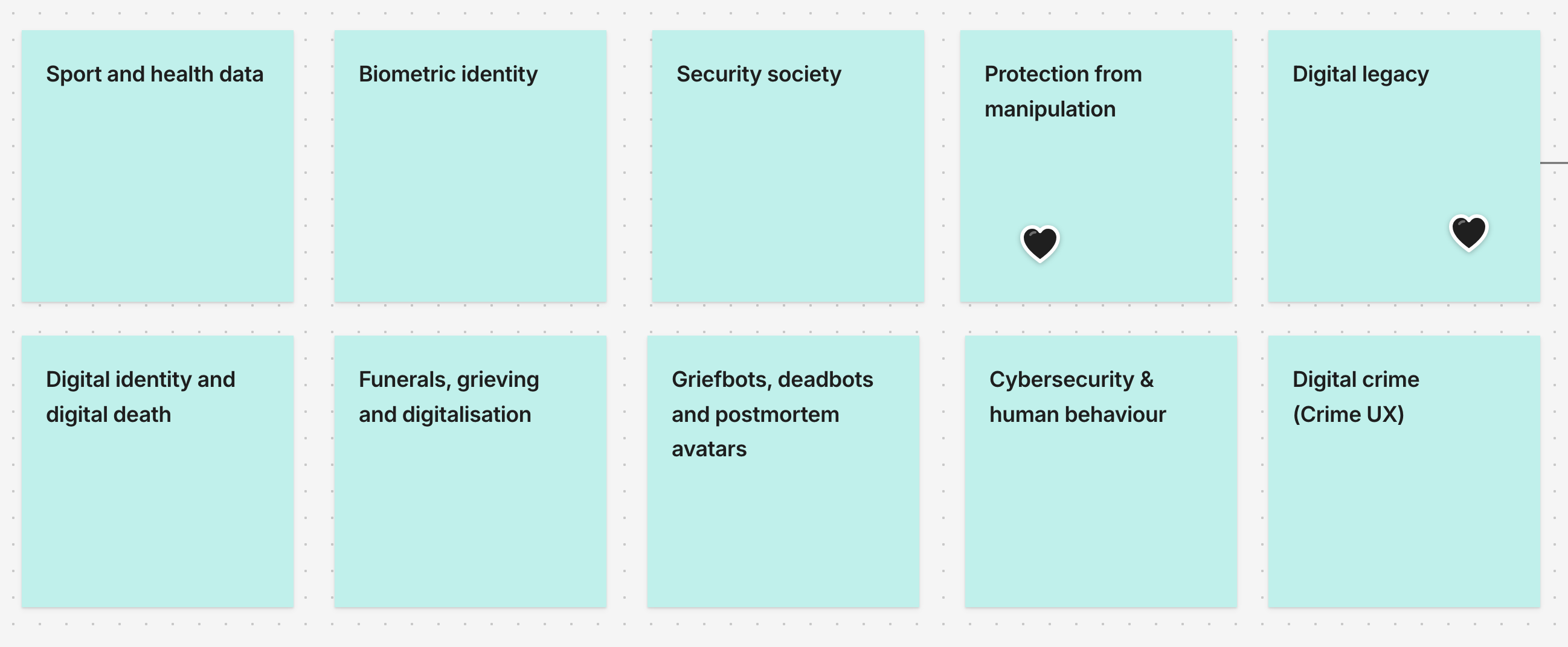
I began with an open collection of themes around data, identity and privacy — from health and biometric data to security, manipulation, digital crime and what happens to our data when we die.
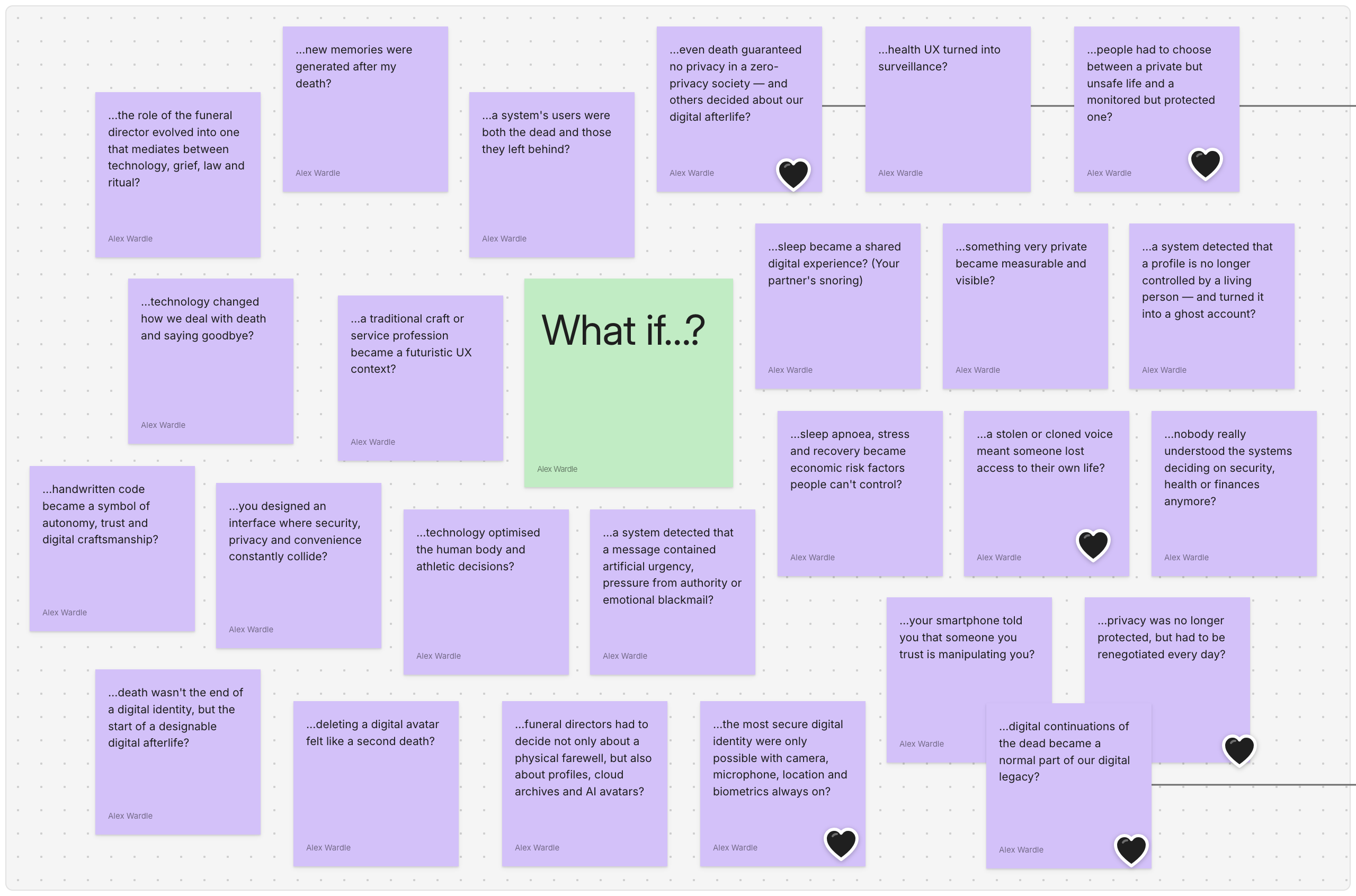
I turned the themes into "What if…?" questions to find the ones with the most tension — like what if digital continuations of the dead became a normal part of our digital legacy, or what if even death offered no privacy, and others decided about our digital afterlife.
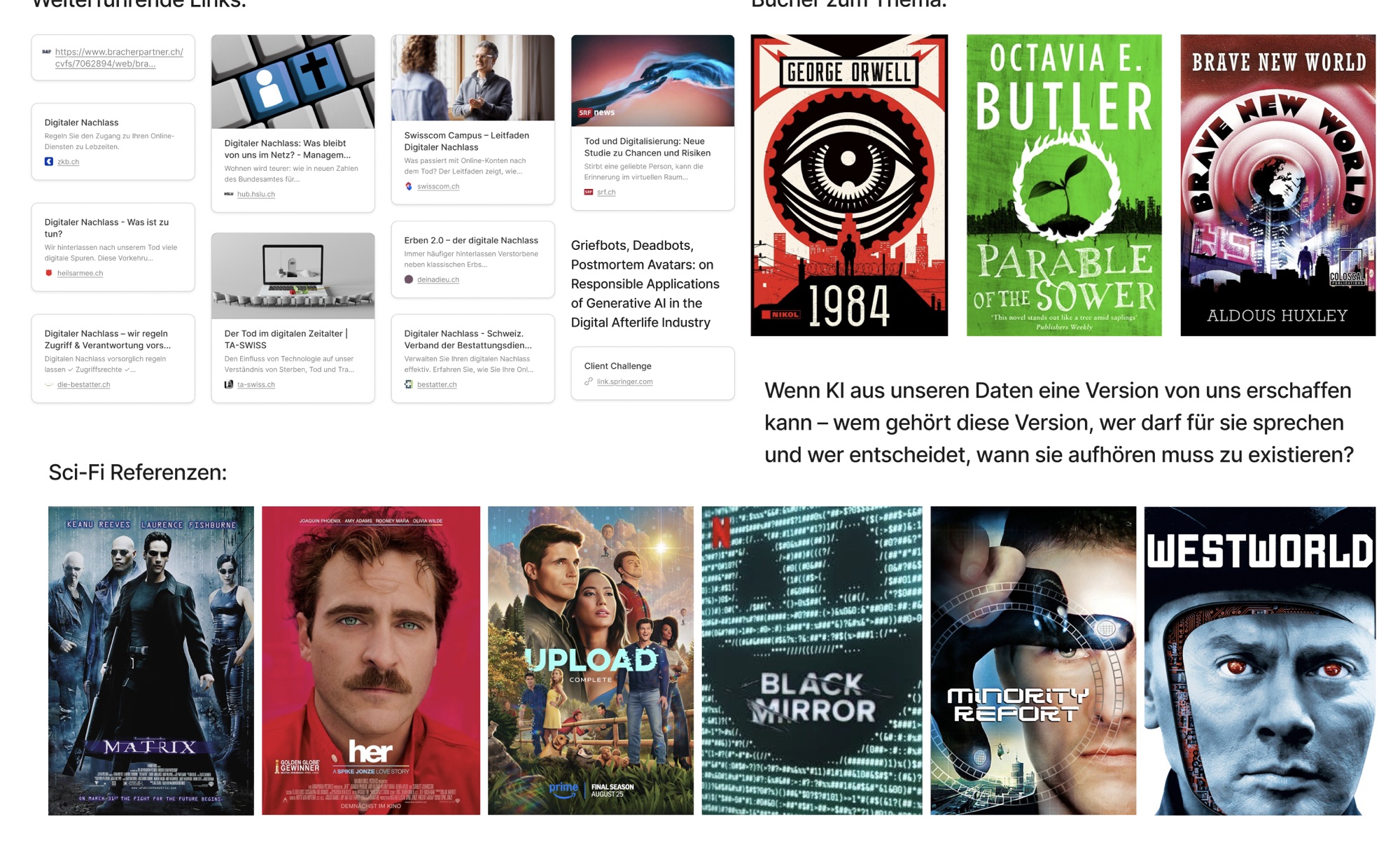
Alongside this, I researched digital legacies, griefbots and the ethics of posthumous AI avatars, using Swiss sources on digital estates as well as research on the digital afterlife industry. Books like 1984 and Brave New World and films and series like The Matrix, Her, Upload and Black Mirror served as reference points.
What interested me most were emotional attachment, surveillance, and the line between a real person and their digital reconstruction. It came down to one question:
If AI can create a version of us from our data — who owns that version, who may speak for it, and who decides when it has to stop existing?
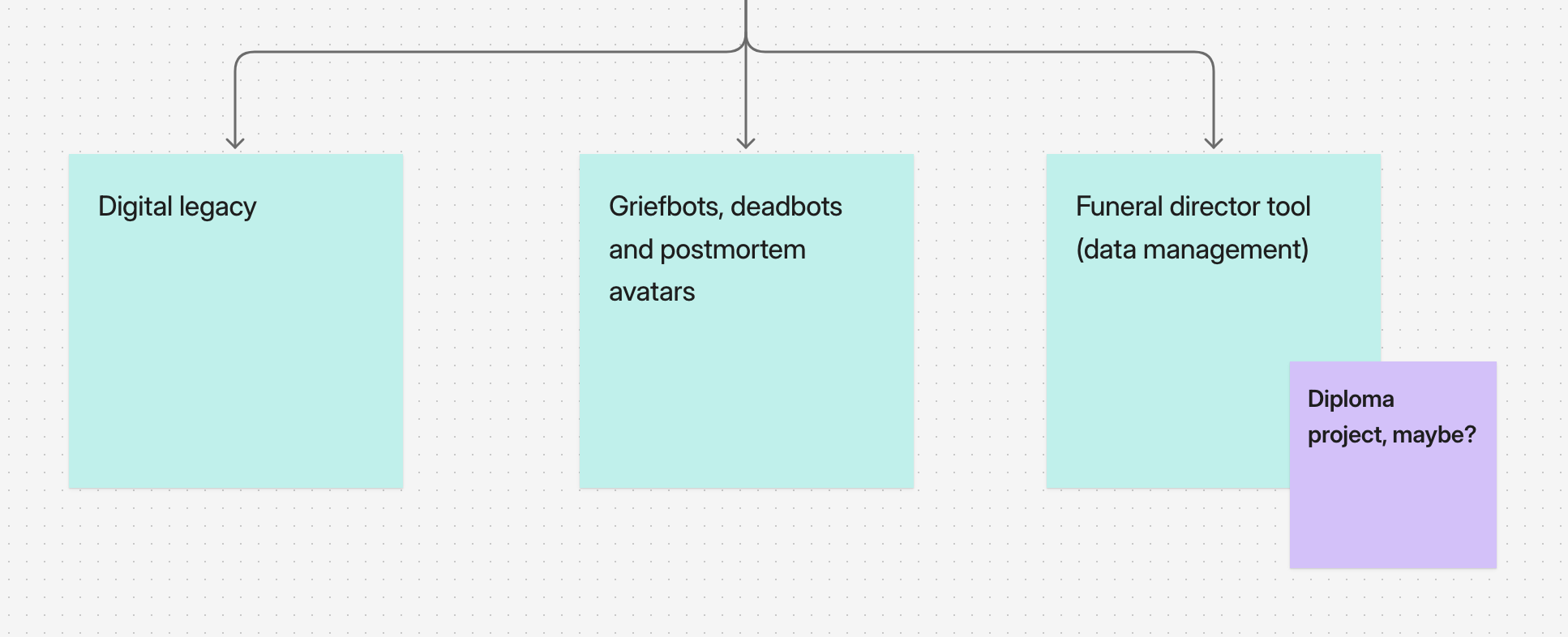
From there, I narrowed the field down to three directions:
- Digital legacy
- Griefbots, deadbots and postmortem avatars
- A data-management tool for funeral directors
From Avatar to Administration
At first I was drawn to the avatar itself: how convincingly could an AI imitate someone who has died?
As the concept developed, I shifted the focus to what sits behind it. Instead of the simulation, I wanted to look at who controls a digital identity — and how an interface shapes the decisions made about it.
That shift changed the central design question. It was no longer about how real a digital person feels, but about how a platform exercises power through roles, permissions, data and interface decisions.
Echo.me became a platform that manages the Continuances of people who have died.
One Family, One Birthday
To make the concept tangible, I built a fictional family scenario.
Mara Voss has died. A Continuance has been created from her digital data, and three people stand in different relationships to it:
Anna
Mara's sister and primary administrator. She is responsible for the Continuance and decides on proposed activities and messages.
Jonas
Mara's partner and co-administrator. He has a right to object to important decisions, and his dissent is visible within the circle of administrators.
Mila
Mara's daughter and a protected recipient. As a child she has limited access to messages and memories, and does not manage her mother's identity herself.
The key moment is Mila's birthday. The platform proposes sending her an AI-generated message in her late mother's name.
Anna has to decide whether to approve it — even though Jonas has concerns.
The User Journey
Anna is reminded of Mila's birthday, reviews a generated message from Mara, checks its data sources and a 92% resonance score, sees that Jonas objects, chooses to approve, talk to Jonas, pause or review the Continuance's boundaries — and the system confirms her choice.
The Interface
Echo.me has two perspectives: an administration interface for relatives, and a reduced mobile app for the people who receive messages.
The main flow is designed in detail as six tablet screens:
- Overview — the Continuance and upcoming events, with Mila's birthday highlighted as a meaningful moment.
- Message Proposal — an automatically generated message, written in Mara's familiar tone, ready for review.
- Resonance & Data Sources — a 92% resonance score and the historical data the proposal is based on.
- Conflict — Jonas's objection, a personal family conflict presented as a neutral system notice.
- Decision — approve, start a conversation with Jonas, pause, or review further boundaries.
- Confirmation & Care Plan — the chosen action, tied back into the ongoing administration and service model.
Three Key Design Decisions
A calm interface for an uncomfortable subject
I deliberately avoided a dark science-fiction look. The interface borrows from familiar administration, healthcare and banking apps — warm neutrals, sage green, clear typography and restrained components that signal safety and care. That makes a deeply strange service feel like an ordinary part of everyday life.
Turning a moral dilemma into a simple workflow
A complex emotional decision is translated into a tidy sequence of notice, proposal, evidence and approval. The approve action is visually weighted more heavily than pausing or reviewing. This is a deliberate, critical choice: it shows how an interface can steer people in one direction without ever telling them what to do.
Making data look like consent
The 92% resonance score suggests the message fits Mara well. But it can only express a match with historical data — it cannot prove Mara would have wanted to send it. The interface questions how numbers get used as a seemingly objective basis for decisions.
What Was Achieved
A speculative product concept with its own visual identity, a developed future scenario, defined roles and permissions, and a six-screen interface prototype.
Alongside it, I created visualisations of the context of use and fictional service artefacts, such as a Continuance handover card, role confirmations and Care Plan notices.
Echo.me isn't a market-ready product and isn't meant to be. It is a design fiction that makes social and ethical questions tangible through a concrete digital application.
What I Learned
Interfaces are never neutral
The way an interface is designed shapes which options people notice, which actions feel easy, and who gets to make decisions at all.
Good usability doesn't automatically mean good design
A smooth flow can be a problem when it makes a morally difficult decision feel too easy.
Data isn't the same as consent
Even with a great deal of information about a person, a system can't reliably infer what they would have wanted in a new situation.
Design fiction makes abstract questions tangible
Concrete people, everyday situations and interface decisions make complex topics like digital self-determination, AI and privacy easier to examine.
What This Taught Me
Echo.me showed me that interaction design goes far beyond individual screens.
I was struck by how much small decisions change the way a technology is perceived: the wording of a button, the weight of an option, the way a conflict is presented.
As a designer, I need to think not only about whether an interaction works, but about what it might lead to.